When a parent is discharged from hospital, or slowly needs more help at home, many Delhi families type the same words into Google: “nursing home near me.” What they often find is a list of small private hospitals and care homes. But there is another option that more families are choosing today: bringing the care home.
This guide explains the difference between a nursing home and home nursing care in plain words, so you can decide what suits your parent, your house and your family. We are Radha Nursing Home Care, and we provide 24-hour live-in care at home. We will be honest about where home care works well, and where a hospital or nursing home is the safer choice.
What people in India mean by “nursing home”
In India, a nursing home usually means a small private hospital with beds, nurses and visiting doctors. Patients stay there for surgery, delivery, observation or treatment. Some places also offer long stays for older people who need regular nursing, and these are sometimes called care homes or old age homes.
The key point is that the patient moves to the facility. The care is organised around the facility’s routine, its staff shifts and its visiting hours.
What home nursing care means
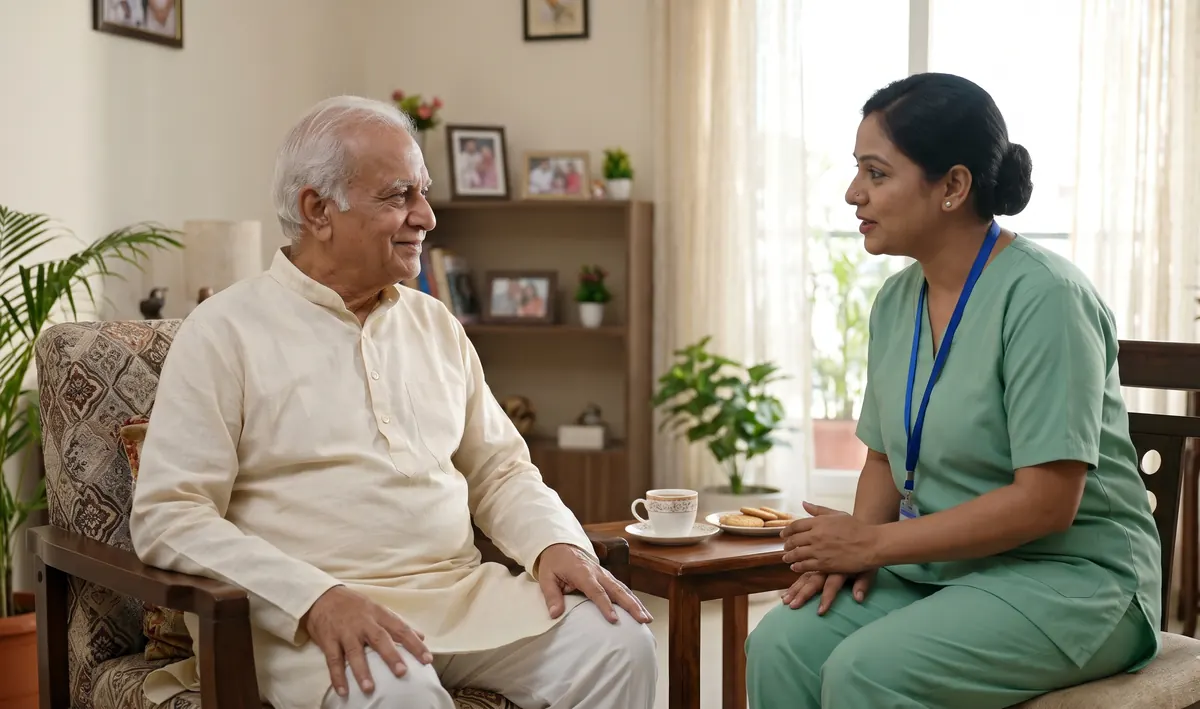
Home nursing care means the care comes to the patient. A trained caregiver or nurse stays in your home and looks after the daily needs: medicines on time, meals, hygiene, safe movement, rest and company. At Radha Nursing Home Care, the caregiver lives with the family for 24 hours a day. We do not offer hourly or 12-hour shifts, because continuity is what keeps a patient safe and calm.
Home care works alongside your doctor. The caregiver follows the doctor’s instructions and tells the family quickly if anything changes. A caregiver does not replace a doctor and does not change treatment.
Side-by-side comparison
| Question | Nursing home / hospital | Home nursing care |
|---|---|---|
| Where does the patient stay? | In a facility, away from family | In their own room, with their own things |
| Who looks after the patient? | Rotating nurses and staff on shifts | One familiar caregiver who learns the routine |
| Family visits | Within visiting hours | Any time, since it is your home |
| Medical emergencies | Doctors and equipment are on site | Family calls the doctor or 112; patient may need to go to hospital |
| Infection exposure | Shared wards and visitors | Familiar home environment |
| Food and routine | Facility timings and menus | Home food and the patient’s own routine |
| Comfort for elders | New place, new faces | Familiar surroundings, which often helps with confusion and anxiety |
When a nursing home or hospital is the right choice
Home care is not for every situation, and a good agency will tell you so. Please choose a hospital or nursing home when:
- The patient has a sudden, serious illness or needs urgent tests, surgery or ICU-level monitoring.
- The doctor has asked for continuous medical supervision that can only be given in a hospital.
- The patient’s condition is unstable and may change within hours.
- There is no safe space or adult at home to support the care at all.
In a medical emergency, always call 112 or your ambulance service first.
When home nursing care works very well
Home care is often a good fit when the hospital has finished its main treatment and the patient needs steady support to recover or to live comfortably. For example:
- After discharge from hospital, when the patient is stable but weak and needs help with medicines, meals and movement.
- Long-term elderly care, where a parent is frail, forgetful or needs daily help, but does not need a hospital bed.
- Stroke, fracture or surgery recovery, where a familiar room and family nearby make a real difference.
- Patients who become anxious or confused in new places, such as some people living with dementia.
- Families who work long hours and cannot be at home all day.
You can read more about what we do on our Home Nursing Care page and our Old Age Care page.
Five questions to help you decide
- What did the doctor say? Ask clearly whether the patient can safely be cared for at home, and what warning signs mean an immediate return to hospital.
- Is the patient stable? Stable patients who need daily support are the best match for home care.
- What does your parent want? Many older people strongly prefer to stay at home. Their comfort matters for recovery too.
- Is there a quiet, safe room? A clean room with a bed, light and access to a bathroom is usually enough to start.
- Can the family stay involved? Home care works best when the family and caregiver share information every day.
What a caregiver can and cannot do
It helps to set expectations early. Our caregivers give medicines as prescribed, note temperature, pulse, blood pressure or sugar as advised, help with bathing, dressing and feeding, support safe movement, keep the room clean and give company. They do not replace your doctor, change treatment on their own, or take on tasks that need a specialist doctor. We also do not provide physiotherapy.
If your parent needs frequent clinical procedures, ask your doctor whether a visiting clinical nurse or a hospital stay is more suitable, and share that advice with us. We would rather you get the right care than the wrong promise.
What about old age homes?
Old age homes are a different choice again. They suit older people who are largely independent and want a community around them. If your parent has strong attachments to their home, neighbours and routine, home care lets them keep all of that. For a closer look, see our guide on how home nursing support works, and read the World Health Organization’s fact sheet on ageing and health for useful background on healthy ageing.
Preparing the home for care
Whichever way you go, a little preparation makes the first weeks calmer. If you choose home care, clear a safe path from the bed to the bathroom, add a night light, keep medicines and important papers in one place and arrange a comfortable spot where the caregiver can rest. If you choose a nursing home, visit in person, check the rooms and the staffing at night, and read the admission terms carefully. For general guidance on caring for someone at home, the National Institute on Aging’s caregiving guide is a trusted and easy-to-read reference.
Related reading
- Old age home vs 24-hour home care: an honest comparison
- Why “nursing home near me” shows hospitals, and what home nursing care means
- What makes nursing care at home in Delhi different from hospitals
- What is included in 24-hour home nursing care in Delhi
Frequently asked questions
Is home nursing care cheaper than a nursing home?
It depends on the kind of care and the length of time. We do not quote fixed rates in articles because every family’s need is different. Call us with the details and we will give you a clear quote, so you can compare it fairly.
Can a patient go back to hospital if needed?
Yes. The caregiver tells the family quickly if anything changes, and the family can call the doctor or 112. Keep the hospital discharge summary and emergency numbers in one place at home.
Do you work with hospitals?
We are an independent home care agency and are not affiliated with any hospital. We work alongside the advice your doctor has given.
Is 24-hour live-in care necessary?
For patients who need help through the night, or who should not be left alone, round-the-clock care is the safest arrangement. That is why we provide only 24-hour live-in care.
Talk to us before you decide
Every family is different, and there is no shame in asking questions. Tell us about your parent and what the doctor has advised, and we will tell you honestly whether home care is a good fit. We serve families across Delhi NCR, including Noida, Gurugram, Faridabad and Ghaziabad.
Call +91-8587808979 or message us on WhatsApp. You can also visit our Contact Us page.