
It is one of the most common questions families ask when they plan care at home: “Will the caregiver give injections or put on an IV drip?” The honest answer matters, because getting it wrong can put a patient at risk. Here is a clear explanation.
The short answer
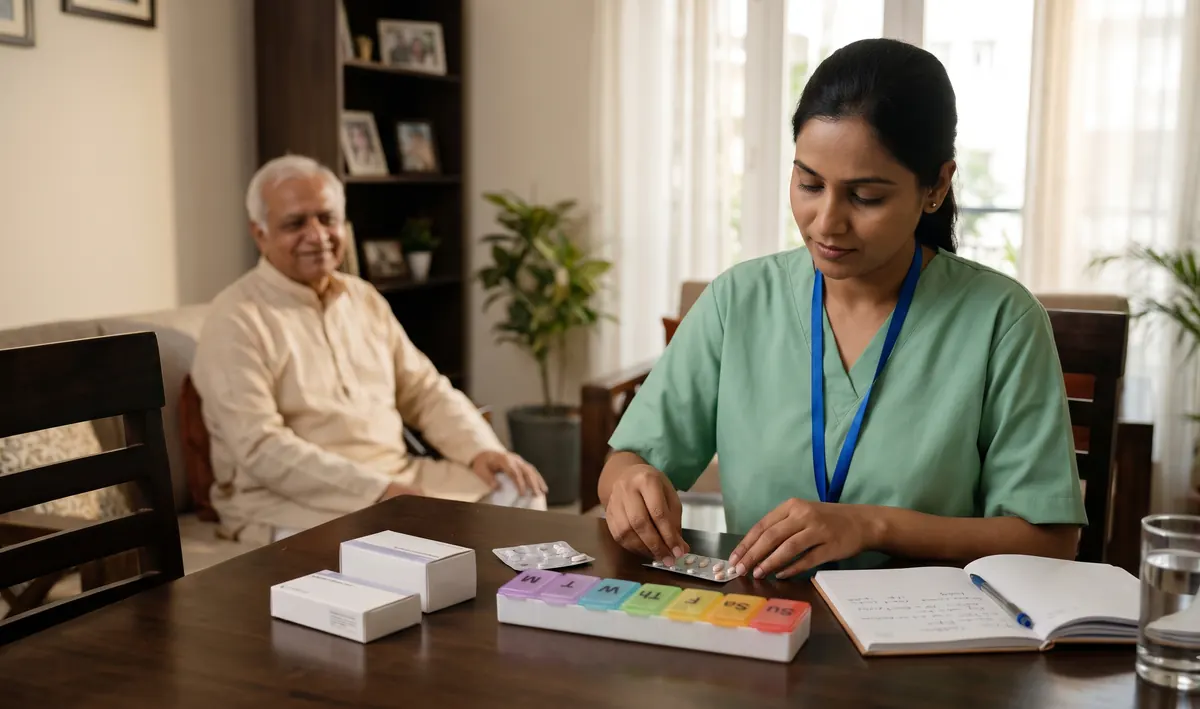
At Radha Nursing Home Care, our live-in caregivers do not give injections or IV drips. They support daily care: medicines that are taken by mouth or applied as the doctor has prescribed, meals, hygiene, safe movement, comfort and company. Anything that needs a clinical procedure should be done by a licensed and qualified professional, as advised by your doctor.
Why the limit exists
Injections and intravenous (IV) treatment carry real risks if not done correctly: infection, wrong dose, allergic reaction and damage to veins. These are clinical tasks that need proper training, sterile equipment and the authority to handle an emergency. That is why they belong with doctors and licensed nurses, not with a general caregiver.
We would rather tell you this clearly now than let a family assume otherwise.
What a caregiver can do
- Give medicines on time as prescribed by the doctor, from a labelled organiser
- Note temperature, pulse, blood pressure or sugar readings as advised and record them
- Help with bathing, dressing, toileting and grooming
- Feed meals as per the diet advice and keep the patient hydrated
- Help the patient to turn, sit, stand and walk safely
- Keep the room clean and comfortable
- Give company and emotional support
- Tell the family quickly if anything changes, so the doctor can be called
What needs a doctor or licensed nurse
- Injections and IV fluids or medicines
- Changing medicines or doses
- Complex wound care or procedures
- Any task the doctor says needs a trained clinical professional
What families usually do
If your doctor has prescribed injections or an IV, many families arrange for a licensed nurse or clinic to visit for those specific tasks, while a live-in caregiver supports everything else around the clock. Ask your doctor or the hospital discharge team how they suggest arranging this, and keep their advice in writing.
Questions to ask the doctor before leaving hospital
- Which treatments need a clinical professional at home, and how often?
- Who should we call if the patient develops a fever, bleeding or sudden pain?
- Which tasks can a trained family member or caregiver safely do?
- What warning signs mean we should return to hospital?
A caregiver helps even when clinical care is needed
Even when a visiting nurse gives the injections, a patient still needs help the rest of the day and night: help to eat, to move, to keep clean and comfortable, and someone to notice small changes. That steady presence is what a live-in caregiver brings. We provide 24-hour live-in care only, and our caregivers follow your doctor’s advice. We also do not provide physiotherapy.
Read more on our Home Nursing Care page and our Patient Care Taker page. For general guidance on caring for someone at home, the National Institute on Aging’s caregiving guide is a helpful read. In a medical emergency, call 112 first.
Why the word “nurse” confuses so many families
In India, people use the word “nurse” for many different roles: a hospital-trained nurse, a home attendant, an ayah, a ward boy or a general duty assistant (GDA). These roles are not the same. A qualified nurse has formal training and a licence to carry out clinical procedures. An attendant or caregiver is trained in daily personal care and companionship. When a family says “we need a nurse for night duty”, the real need may be a caregiver who can help the patient to the bathroom and give prescribed tablets, or it may be a licensed nurse who must give an injection. Our post on medical vs non-medical patient care in Delhi NCR explains the difference in more detail.
Everyday tasks families often ask about
Between “daily care” and “injections” there is a grey area of tasks that families regularly ask about. Here is how we think about them. In every case, the doctor’s instructions come first.
- Giving tablets, syrups and eye or ear drops as prescribed: yes, as part of daily care, from a labelled organiser and according to the doctor’s timings.
- Applying a prescribed ointment or cream: yes, if the doctor has explained where and how often, and the skin is intact.
- Checking temperature, pulse, blood pressure or blood sugar: yes, where the doctor has asked for readings, and the caregiver notes them for the family and doctor.
- Helping with a nebulizer or oxygen concentrator: only after the doctor or supplier has shown the family and the caregiver how to use it safely.
- Injections, insulin by injection, IV drips, injecting through a feeding tube or changing complex dressings: no. These need a qualified clinical professional, as advised by the doctor.
- Changing medicines or doses: never. Only the doctor can do this.
If you are unsure about a particular task, ask your doctor, and ask us. We would rather say “we cannot do this” than take a risk with your family member.
How a visiting nurse and a live-in caregiver can work together
Many families find that the best arrangement is a mix. A licensed nurse or clinic visits for the specific clinical tasks the doctor has prescribed, and a live-in caregiver supports the patient for the rest of the day and night. For this to work smoothly:
- Share the visiting nurse’s timings and instructions with the caregiver.
- Keep one notebook where both the nurse and the caregiver write their observations.
- Make sure the family member in charge knows who to call for what, and has all numbers on one card.
- Ask the visiting nurse to tell the caregiver what to watch for between visits, such as redness, swelling, fever or pain.
- Let the doctor know about anything unusual before the next visit, not after.
Safe medicine habits at home
Whoever gives medicines, a few habits protect the patient. Keep medicines in their original packs or a labelled organiser, away from children and out of sunlight. Check expiry dates once a month. Never share one person’s medicines with another. Keep an up-to-date written list of every medicine, dose and timing. When a doctor changes a prescription, remove the old medicine from the box. The National Institute on Aging’s guide to medicines and medication management offers more practical tips, and the Ministry of Health and Family Welfare website is the official source for health information in India.
Related reading
- Do you need a doctor’s prescription before hiring a nurse at home?
- Nursing home vs home nursing care: which is right for your parent?
- What is included in 24-hour home nursing care in Delhi
- Questions to ask a home nursing agency before hiring in Delhi
Frequently asked questions
Is a caregiver the same as a nurse?
No. A caregiver or attendant supports daily care. A nurse is a trained clinical professional who can do procedures within their licence. Choose according to what the doctor has advised.
Can a caregiver help with oxygen or a nebulizer?
Ask your doctor or the equipment supplier to show the family and caregiver how to use it safely. Follow the supplier’s and doctor’s instructions.
What if the doctor asks for an injection every day?
Ask the doctor to suggest a licensed nurse or clinic for those visits, and arrange a live-in caregiver for the rest of the care.
Tell us what you need
If you are not sure what kind of help your parent needs, call us. We will listen, tell you honestly what we can and cannot do, and suggest a suitable plan. We serve Delhi NCR, including Noida, Gurugram, Faridabad and Ghaziabad.
Call +91-8587808979 or message us on WhatsApp. You can also use the Contact Us page.