When a loved one has been in hospital for days or weeks, the family starts asking the same question: “When can we take them home?” The hospital bed feels safe because doctors and nurses are close by. Home feels better for the heart, but it also raises worries. Who will give medicines on time? What if something goes wrong at night?
There is no single right answer, and nobody should rush you. Below is how families usually think through hospital stay vs home care: who decides, what to ask before discharge, and what changes once your parent is back in their own room. This is general guidance only, and your doctor’s advice always comes first. We are a home care agency in Kalkaji, New Delhi, so we are happy to say plainly when staying in hospital a little longer is the safer choice.
Who decides when a patient can go home?
The treating doctor decides, not the family and not the home care agency. A patient is usually discharged when the main reason for admission has been treated, the condition is stable, and the doctor believes the patient can continue recovering outside hospital with the right support. Families sometimes feel pressure from both sides: the hospital wants the bed for someone else, while relatives want more time. The best approach is to ask direct questions and write down the answers.
What “stable” usually means for families
Doctors use the word “stable” to say the condition is not changing rapidly. It does not mean the patient is back to normal. A stable patient may still be weak, may need help to sit, eat or walk, and may need regular medicines for weeks. That gap between “stable” and “fully independent” is exactly where good home care matters.
Questions to ask the discharge team
Before you agree to a discharge date, ask the doctor or the discharge nurse these questions and keep the answers in writing:
- What was treated, and what is the plan for the next few weeks?
- Which medicines must be given, at what times, and what happens if a dose is missed?
- What diet and fluid advice applies? Are there any restrictions?
- How much can the patient move? Can they sit up, stand, walk or climb stairs?
- Is any clinical procedure needed at home, such as a dressing change or an injection, and who should do it?
- Which warning signs mean we should call you, and which mean we should return to hospital straight away?
- When is the follow-up visit, and which reports should we bring?
Our guide on whether you need a prescription before hiring a nurse at home explains why these written instructions are so useful for any caregiver.
Hospital stay vs home care: a side-by-side view
| Question | Hospital | Home with 24-hour live-in care |
|---|---|---|
| Medical monitoring | Doctors, equipment and specialists on site | Family and caregiver note changes and call the doctor or 112 |
| Rest and sleep | Noise, lights and shared wards | Own room and familiar routine |
| Infection exposure | Shared spaces and many visitors | A quieter, more controlled environment |
| Food | Hospital menu | Home food within the doctor’s diet advice |
| Family involvement | Visiting hours | Any time of day |
| Emotional comfort | New place, new faces | Familiar people and surroundings |
When staying in hospital is the better choice
Home care is not right for every situation. Please keep the patient in hospital, or follow your doctor’s advice to stay, when:
- The condition is still changing from hour to hour or needs continuous clinical monitoring.
- The doctor says treatment such as intravenous medicines must continue in hospital.
- There is no safe place at home for the patient, or no adult available to support them.
- The patient is in severe pain, breathless or confused and has not yet been settled.
In an emergency, always call 112 or your ambulance service first. If you are unsure, it is fine to say to the doctor, “We are not ready yet. What would make it safe?”
When home care works well
Home care is often a good fit after the main treatment is finished, for example after surgery, a fracture, a stroke or a long illness, when the patient is stable but still needs daily help. Many families notice that elderly patients, especially those who get confused in new places, sleep and eat better at home. For a wider comparison, read our article on nursing home vs home nursing care in Delhi.
What a 24-hour live-in caregiver does at home
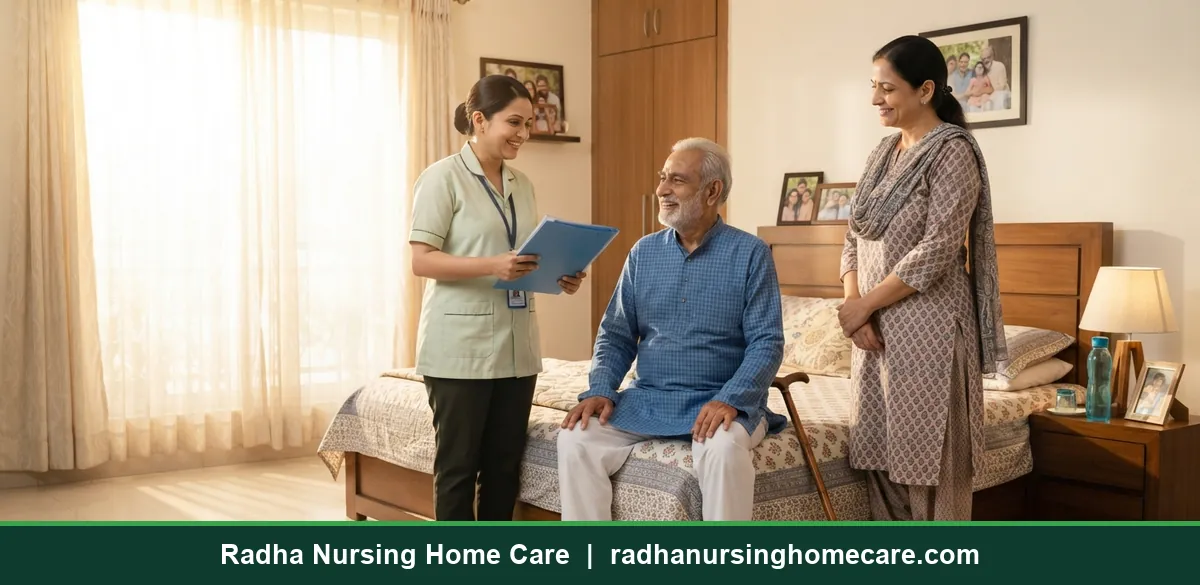
At Radha Nursing Home Care we provide 24-hour live-in care only. We do not do hourly or 12-hour shifts. The first days at home are when gaps hurt most, and a shift always leaves some: the early morning, the evening, the night. The caregiver lives with the family and helps with:
- Giving medicines on time, exactly as the doctor has prescribed
- Noting temperature, pulse, blood pressure or sugar when the doctor has asked for readings
- Help with bathing, dressing, toileting and grooming
- Meals, fluids and a clean, comfortable room
- Safe movement: turning, sitting, standing and walking as the doctor allows
- Company, and quick information to the family when anything changes
You can read more on our Home Nursing Care page and our Patient Care Taker page.
What home care does not do
Our caregivers do not replace the doctor, change treatment or decide on medicines. Injections, IV drips and physiotherapy are outside what they do; injections and IV at home covers the reasoning. When the doctor orders clinical care, most families bring in a licensed nurse or clinic for just those visits and keep the live-in caregiver for the daily work.
Getting the home ready before discharge
- Choose a quiet room, ideally near a bathroom, with good light and a bed that is easy to get in and out of.
- Clear the path from the bed to the bathroom, remove loose rugs and add a night light.
- Keep medicines, reports, the discharge summary and emergency numbers in one place.
- Arrange a chair, a flask and a small table within reach of the bed.
- Plan where the caregiver will rest and keep their belongings.
If you would like a neutral outside reference, the National Institute on Aging’s caregiving guide is a trusted and easy read, and the World Health Organization’s fact sheet on ageing and health gives useful background.
The first few days at home
The first days are about settling in. Expect tiredness, poor appetite and some anxiety, both for the patient and for the family. Keep the routine simple and steady: medicines at the same times, small meals, rest in between and short visits. Write down anything unusual, such as a new cough, a fever, a drop in appetite, more confusion or a swollen limb, and share it with the doctor early. A live-in caregiver helps here because the same person sees the patient through the day and night and notices small changes.
Warning signs: call the doctor or 112
- Trouble breathing, chest pain, or blue or grey lips
- Sudden confusion, fainting or extreme drowsiness
- Heavy bleeding, a high fever that does not settle, or severe pain
- Any sign the doctor listed as a reason to return to hospital
Related reading
- What does a live-in caregiver’s day look like?
- Old age home vs 24-hour home care
- What is included in 24-hour home nursing care in Delhi
- Old Age Care services
Frequently asked questions
Can we take a patient home against the doctor’s advice?
Families have the right to make decisions, but leaving against advice can be risky. Talk openly with the doctor about your worries and ask what would make going home safe.
Does a patient need a caregiver the moment they come home?
Many families arrange help before discharge, so the caregiver is present on day one and learns the routine from the start.
Do you have beds or a facility?
No. We are a home care agency and our caregivers live in your home. We are not a hospital and are not affiliated with any hospital.
Talk to us before discharge day
If your parent or patient is about to be discharged, call us a few days early so we can understand the doctor’s advice and suggest a suitable 24-hour live-in caregiver. We serve families across Delhi NCR, including Noida, Gurugram, Faridabad and Ghaziabad. Learn more about us.
Call +91-8587808979 or message us on WhatsApp. You can also visit our Contact Us page.