
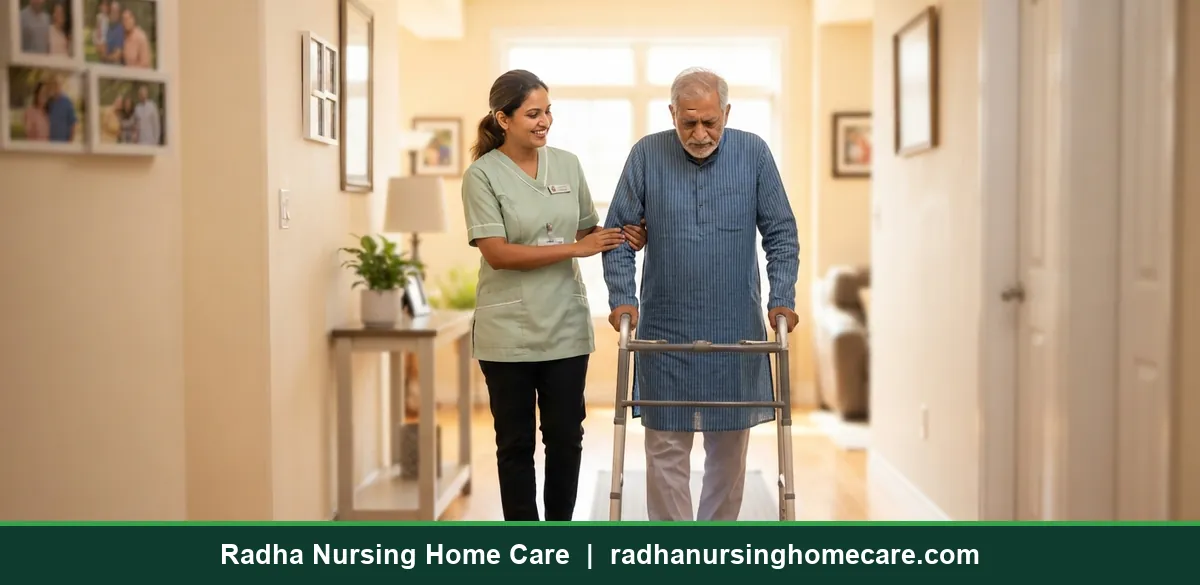
If you are searching for “GDA staff for home”, you probably know that a general duty assistant helps with a patient’s daily care, but you may not be sure what that includes in practice. Can a GDA give medicines? Will they bathe the patient? Can they handle night duty? And what should they never do?
So, what does a GDA do at home? In short, a GDA looks after the patient’s daily living: washing, eating, moving safely, medicines as prescribed and company. Below are the duties in detail, what the role does not include, and a few tips for working well with a caregiver. We provide 24-hour live-in caregivers across Delhi NCR, so we have added notes on how our own service works.
What “GDA” means
GDA stands for general duty assistant. In hospitals, GDAs support nurses and patients with non-clinical tasks such as helping patients move, keeping beds clean and assisting with personal care. At home, the term is used more loosely for a person who looks after a patient’s daily needs. Different agencies train and describe their staff differently, so always ask what training the person has and which tasks they will carry out.
If you are unsure how a GDA differs from a nurse, read our comparison of a home nurse and a patient attendant (GDA).
Core duties of a GDA at home
Personal care
- Helping the patient wash, bathe, brush teeth, dress and groom
- Helping with toileting, including bedpan, commode or bathroom support
- Changing clothes and bedding to keep the patient clean and comfortable
- Paying attention to dignity and privacy at all times
Eating and drinking
- Serving meals as per the doctor’s diet advice
- Helping the patient eat, sitting upright when allowed
- Offering fluids regularly, within any limits set by the doctor
- Noting how much the patient has eaten and drunk
Movement and safety
- Helping the patient turn, sit, stand and walk as the doctor allows
- Preventing falls by keeping the floor dry, the path clear and a night light on
- Using a walker, wheelchair or commode as advised
- Following the way the doctor or nurse has shown for turning and positioning
Medicines and readings
- Giving prescribed medicines on time from a labelled organiser
- Noting temperature, pulse, blood pressure or sugar readings when the doctor has asked for them
- Recording everything in a daily notebook for the family and the doctor
Room and routine
- Keeping the patient’s room clean, aired and comfortable
- Following a steady routine for meals, rest, medicines and visitors
- Giving company and conversation, which matters especially for older people
Communication
- Telling the family promptly about any change in the patient’s condition or mood
- Passing on the doctor’s instructions to the next family member in charge
- Asking before doing anything that they have not been shown
What a GDA does not do
The limits matter as much as the duties. A general duty assistant does not replace the doctor and does not change treatment. In our service the line is clear: no injections or IV drips, no decisions about medicines or doses, and no physiotherapy. If the doctor has asked for clinical procedures at home, families usually arrange a licensed nurse or clinic for those visits. Our article on injections and IV at home explains why.
A typical day with a live-in GDA or caregiver
| Time of day | What usually happens |
|---|---|
| Early morning | Help to wake up, use the bathroom, wash and change; first fluids |
| Morning | Medicines as prescribed, breakfast, readings if asked, gentle movement |
| Midday | Lunch, rest, room cleaning, company |
| Afternoon | Quiet time, visitors, doctor calls, tea or a light snack |
| Evening | Dinner, evening medicines, washing up for the night |
| Night | Close by and ready to help with the bathroom, discomfort or confusion |
For a fuller picture, read what a live-in caregiver’s day looks like.
Why live-in matters for GDA-type care
Many agencies send a GDA for an 8-hour or 12-hour shift. Ours live in: 24-hour live-in care is all we offer. Here is why: a patient who needs daily help also needs someone at night, in the early morning and in the quiet hours when small problems begin. One caregiver who lives with the family learns the patient’s habits, notices changes and builds trust. You can read more about each service on our Home Nursing Care, Patient Care Taker and Old Age Care pages.
How families can work well with a caregiver
- Share the doctor’s advice on day one. Give the caregiver the prescription, the medicine list and the diet instructions.
- Name one family contact. Mixed instructions from many relatives cause confusion.
- Keep a daily notebook. Medicines given, meals, fluids, sleep, readings and mood in one place.
- Give a quiet place to rest. A rested caregiver is a better caregiver.
- Speak kindly and clearly. Raise concerns early and calmly.
- Respect privacy and dignity for both the patient and the caregiver.
Families often ask where to read more, and the National Institute on Aging’s caregiving guide offers helpful tips for families, and the World Health Organization’s fact sheet on ageing and health explains the wider picture of older people’s needs.
Questions to ask before hiring
- What training and experience does the person have?
- How is the person verified, and can we see identity documents?
- Which tasks will they do, and which will they not do?
- Is the care live-in or shift-based, and how will rest and relief work?
- What happens if the match is not a good fit?
Our guide on questions to ask a home nursing agency before hiring has the longer list.
Warning signs: call the doctor or 112
Whoever is caring for the patient should tell the family and the doctor at once if there is a fever that does not settle, new confusion, a fall, fast or difficult breathing, chest pain or sudden weakness. In an emergency, call 112 first.
Related reading
- What is included in 24-hour home nursing care in Delhi
- How do I find a patient care taker for my parent in Delhi?
- How fast can a caregiver be arranged in Delhi NCR?
- Do you need a prescription before hiring a nurse at home?
Frequently asked questions
Can a GDA give medicines?
Yes, prescribed medicines taken by mouth or applied as the doctor has explained can be given as part of daily care. Only the doctor can change a medicine or a dose.
Can a GDA do night duty?
Our live-in caregivers stay in the home day and night and rest in the house, close by and ready to help if needed.
Does a GDA cook?
Preparing the patient’s meals may be part of the arrangement in some homes. If you need regular cooking help, ask about our 24-hour cooking maid.
Looking for a caregiver for your family?
Tell us about your parent or patient and what the doctor has advised, and we will suggest a suitable 24-hour live-in caregiver. We serve Noida, Gurugram, Faridabad, Ghaziabad and Delhi. Learn more about us.
Call +91-8587808979 or message us on WhatsApp. You can also visit our Contact Us page.