
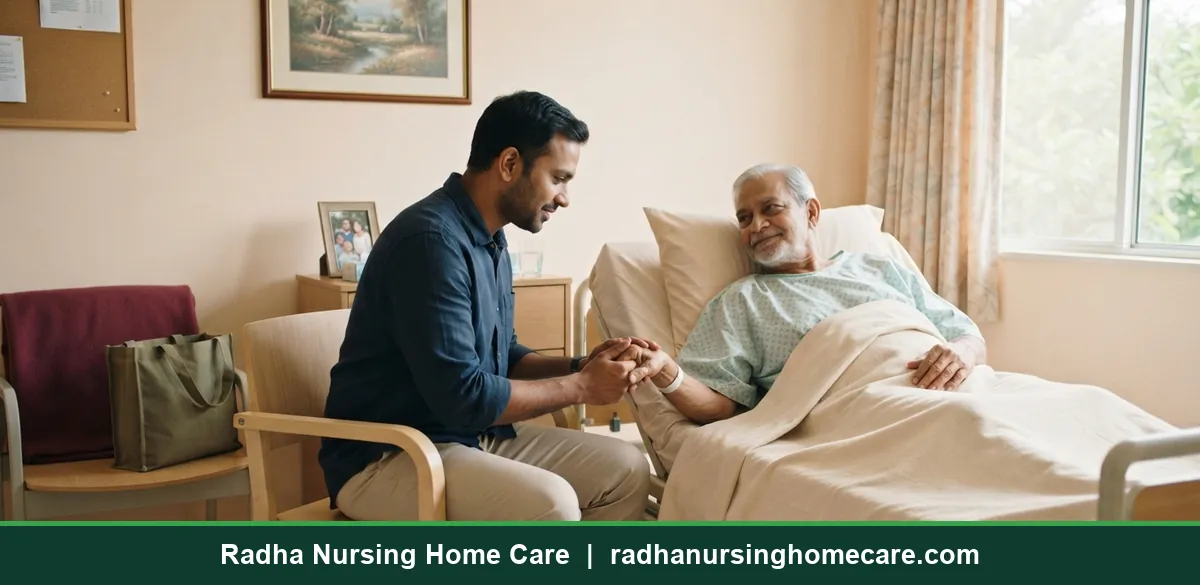
When a parent is admitted to hospital, families quickly face a practical question: “Can someone stay with the patient in the room, especially at night?” Older patients can become confused in a new place, they may need help to use the bathroom, and relatives cannot always be there. Many families wonder whether a hired caregiver or attendant can stay in the hospital room too.
Rules differ from one hospital to another, so the hospital’s own policy always comes first. Below is what families usually need to find out: what is commonly allowed in a hospital room, the questions to ask at the ward desk, and how to plan for the day the patient comes home.
The short answer
It depends on the hospital, the ward and the patient’s condition. Many hospitals allow one family member or attendant to stay with a patient, often with a pass or a name entry at the reception. Intensive care units and some special wards usually have stricter rules, with fixed visiting hours and no one staying. The hospital decides, and it is best to ask before the patient is shifted to a room.
Why families want someone to stay
- Older patients may feel anxious or confused in an unfamiliar place, especially at night.
- Some patients need help to sit up, drink, eat or reach the bathroom, and nurses cannot be at the bedside all the time.
- Family members may be exhausted after days of staying awake, or may have to go to work.
- Someone familiar can pass on the patient’s habits, allergies and fears to the staff.
Questions to ask the hospital
- Is one attendant allowed to stay in the room, and is a pass needed?
- Can the attendant be a family member only, or can a hired caregiver stay too?
- What are the visiting hours, and do they differ for the ward and for the ICU?
- Are there rules about food, bedding, mobile phones or personal belongings?
- Does the hospital provide its own attendants or ward staff for personal care, and what do they do?
- Who should the attendant speak to if they notice a change in the patient?
Write down the answers and the name of the person who gave them. Policies can change between wards.
What a family attendant or caregiver can do in a hospital
In hospital, doctors and nurses are responsible for medical care. A person staying with the patient can support them in non-clinical ways. This may include giving company, helping the patient sit up or reach for a drink as staff permit, informing the nurse promptly if the patient seems uncomfortable, and remembering what the doctor said during rounds. They should never change the patient’s treatment, give medicines on their own, adjust equipment or remove drips and tubes.
What not to do
- Do not give food or drink unless the staff say it is allowed. Some patients are kept nil by mouth before procedures.
- Do not bring or give medicines from home without the doctor’s knowledge.
- Do not touch or adjust IV lines, monitors, oxygen or other equipment.
- Do not argue with ward staff. If you are worried, ask politely for the nurse in charge or the doctor.
- Do not move a patient who has had surgery, a fracture or a stroke without asking the nurse how it should be done.
Looking after the person who stays
Staying in a hospital room is tiring. Whoever stays needs rest, regular meals and short breaks. If one relative does it for many days, it helps to share the nights between two or three family members. Keep a small bag ready with a charger, a notebook, water and a light shawl. The National Institute on Aging’s caregiving guide has practical tips on avoiding caregiver burnout.
Planning for the day the patient comes home
Hospital stays end, and the bigger question is often what happens next. Patients usually leave hospital weak, with new medicines and a long list of instructions. This is the stage where a caregiver can make the biggest difference. Our guide on hospital stay vs home care explains how to decide when going home is safe and what to ask the doctor.
Before discharge, ask the team for:
- A written discharge summary and the latest prescription
- A list of medicines with timings and what each is for
- Diet, fluid and activity advice
- Warning signs and the number to call
- The date of the follow-up visit
Our post on whether you need a prescription before hiring a nurse at home explains why these papers are so useful.
Where a 24-hour live-in caregiver fits
Radha Nursing Home Care provides 24-hour live-in care at the patient’s home. The caregiver lives with the family and helps with daily care, medicines as prescribed, meals, hygiene, safe movement and company, following your doctor’s advice. There are no hourly or 12-hour shifts. The doctor decides treatment, and injections, IV drips and physiotherapy are outside what our caregivers do.
If you are thinking about help while the patient is still in hospital, speak to the hospital about its rules first, and then call us so we can understand the situation and tell you honestly what we can and cannot do. Many families arrange a caregiver a few days before discharge, so that the person is at home, has met the family and is ready when the patient arrives. Read more on our Home Nursing Care and Patient Care Taker pages.
How to prepare the home while the patient is in hospital
- Choose a quiet, well-lit room close to a bathroom, and keep the path clear.
- Prepare a bed that is easy to get in and out of, with a clean, firm mattress.
- Place a chair, a small table and a night light near the bed.
- Remove loose rugs and anything that could cause a fall. The WHO fact sheet on falls explains why this matters for older people.
- Arrange a labelled medicine box, a thermometer and a notebook for daily notes.
- Keep the doctor’s number, the hospital’s number and 112 written near the phone.
Warning signs to tell the nurse right away
If you are staying with a patient in hospital, tell the nurse promptly if you notice:
- Trouble breathing, chest pain or blue lips
- New confusion, extreme drowsiness or a patient who is hard to wake
- Heavy bleeding, a fall, severe pain or a sudden fever
- Any drip, tube or monitor alarm that you do not understand
At home, call the doctor, or call 112 in an emergency.
Related reading
- How fast can a caregiver be arranged in Delhi NCR?
- Nursing home vs home nursing care in Delhi
- What does a live-in caregiver’s day look like?
- Old Age Care services
Frequently asked questions
Can two people stay in a hospital room at night?
Most hospitals allow only one attendant at a time. Ask the ward staff about their rule.
Can a hired caregiver be the attendant?
Some hospitals allow it with a pass, and others prefer family members. Confirm with the hospital first.
Do you have a hospital or beds?
No. We are a home care agency, not a hospital, and are not affiliated with any hospital.
Planning for the move back home?
Call us a few days before discharge and tell us about your parent or patient. We serve Delhi NCR, including Noida, Gurugram, Faridabad and Ghaziabad. Learn more about us.
Call +91-8587808979 or message us on WhatsApp. You can also visit our Contact Us page.