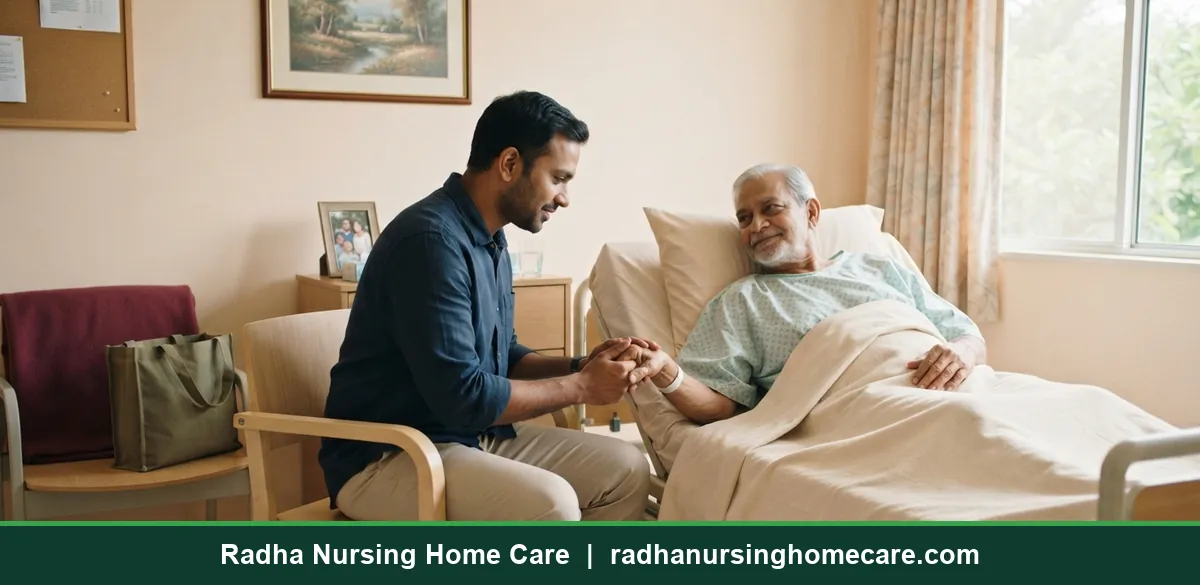
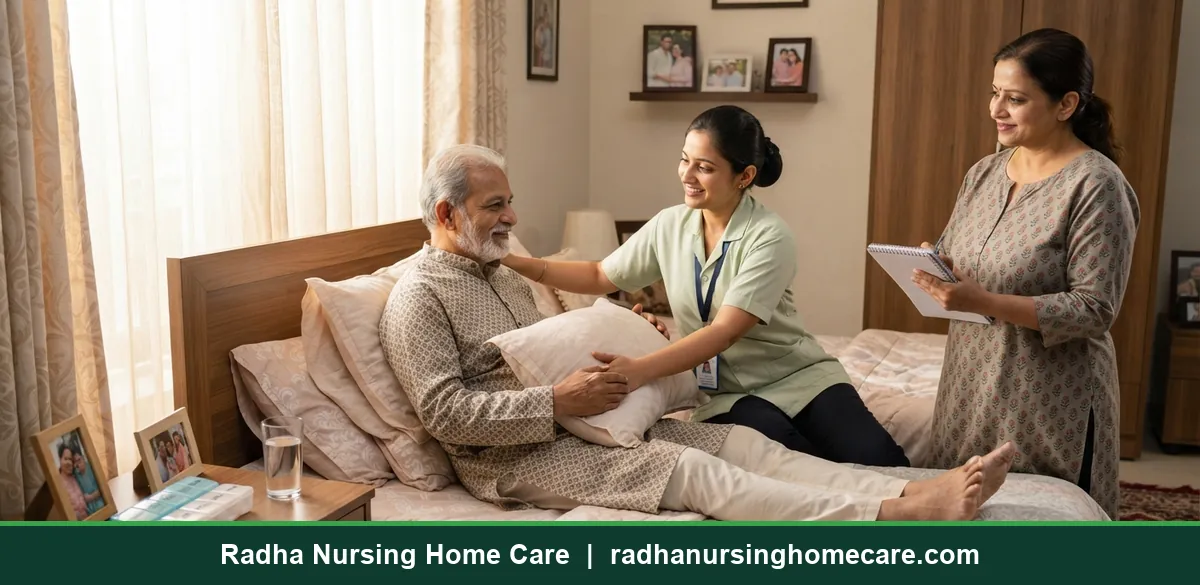
Families searching for help at home often type “nurse” when they mean “someone to look after my father”. Providers add to the confusion by using the words nurse, attendant, GDA, ayah, caretaker and caregiver as if they meant the same thing. They do not. Choosing the wrong kind of help can leave a patient without the support they actually need, or leave a family paying for a service they did not require.
Home nurse vs patient attendant: what is the real difference? In short, a nurse carries out clinical tasks the doctor has prescribed, while an attendant (often called a GDA, or general duty assistant) looks after daily living. Which one you need depends on what the doctor has asked for at home. We provide live-in caregivers for daily care, so we will also tell you straight when a licensed nurse is the better choice.
Why the words are so confusing
In India, the word “nurse” is used loosely. A person with formal nursing training and a licence to carry out clinical procedures is a nurse. A person who helps a patient bathe, eat, move and take prescribed tablets is an attendant or caregiver. In many homes, both are called “nurse” for convenience, and agencies sometimes advertise one while sending the other. Always ask exactly what training the person has and what tasks they are allowed to do.
What a home nurse does
A home nurse is a trained, licensed clinical professional. Depending on the qualification and the doctor’s instructions, a nurse may carry out clinical tasks such as giving injections, managing intravenous treatment, changing surgical or complex dressings and monitoring medical equipment. These tasks carry risks if done wrongly, which is why they need proper training and the doctor’s written instructions.
Nurses may visit for a set time or may be arranged for specific procedures. Families often use a nurse when the doctor says that a clinical procedure is needed at home.
What a patient attendant or GDA does
A patient attendant or general duty assistant supports the patient’s daily living. The role is about personal care, comfort and safety rather than clinical procedures. Typical tasks include:
- Helping the patient bathe, dress, use the toilet and keep clean
- Feeding meals and encouraging fluids as the doctor has advised
- Helping the patient turn, sit, stand and walk safely
- Giving prescribed medicines on time from a labelled organiser
- Noting temperature, pulse, blood pressure or sugar readings when the doctor has asked for them
- Keeping the room clean and comfortable, and giving company
- Telling the family quickly if anything changes
Our article on medical vs non-medical patient care in Delhi NCR explains this difference in more detail.
Side-by-side comparison
| Question | Home nurse | Patient attendant / GDA / caregiver |
|---|---|---|
| Main role | Clinical tasks as prescribed by the doctor | Daily personal care, comfort and safety |
| Injections and IV | Within their licence and the doctor’s instructions | Not done by our caregivers |
| Bathing, feeding, toileting | Possible, but not the main role | Core part of the job |
| Medicines by mouth | Yes, as prescribed | Yes, as prescribed, from a labelled organiser |
| Company and routine | Limited by visit time | Steady presence, especially with live-in care |
| Typical use | When a clinical procedure is needed at home | When the patient needs help with daily living |
So who do you actually need?
Start with the doctor’s discharge advice and ask two questions: “Does the patient need any clinical procedure at home?” and “Does the patient need help with daily activities?” The answers usually point the way.
You mainly need a caregiver or attendant if:
- The patient is stable but weak and needs help with bathing, eating, moving and medicines
- An elderly parent is frail, forgetful or at risk of falls and should not be left alone
- The patient is recovering from a fracture, stroke or surgery and the doctor has not asked for clinical procedures
- The family works long hours and cannot be present all day
You need a licensed nurse if:
- The doctor has asked for injections, IV fluids or complex dressings at home
- The patient has medical equipment that needs clinical handling
- The doctor says the condition requires regular clinical assessment
You may need both:
Many families combine the two. A licensed nurse or clinic visits for the specific clinical tasks, and a live-in caregiver supports the patient for the rest of the day and night. This often works better than asking one person to do everything. Our guide on injections and IV at home explains how families usually arrange this.
What we provide at Radha Nursing Home Care
We provide 24-hour live-in care only. Our caregivers live with the family and help with daily care, medicines as prescribed, meals, hygiene, safe movement and company, and they follow your doctor’s advice. Treatment decisions stay with the doctor, and injections, IV drips and physiotherapy are not part of our service. We also do not send people on hourly or 12-hour shifts. You can read about each service on our Home Nursing Care, Patient Care Taker and Old Age Care pages.
Questions to ask any agency
- Is the person a licensed nurse, or an attendant trained in daily care?
- Exactly which tasks will they do, and which will they not do?
- How are they verified, and can we see their identity documents?
- Is the care live-in, or does it come in shifts, and how does rest and relief work?
- What happens if the match is not right?
- Can we have the terms in writing?
If an agency promises to do everything, including clinical procedures, without asking about the patient’s condition, be careful. Our post on questions to ask a home nursing agency before hiring has a longer list.
Common mistakes families make
- Hiring a “nurse” for tasks that really need an attendant. This can mean paying for clinical skills you do not need.
- Hiring an attendant for clinical tasks. This can put the patient at risk.
- Not asking what the doctor has advised. The doctor’s written plan should guide the choice.
- Choosing shifts that leave gaps. Nights and early mornings are often the hardest hours.
- Forgetting the caregiver’s rest. A tired caregiver cannot give good care.
For a neutral view on home caregiving, the National Institute on Aging’s caregiving guide is a helpful reference, and the Ministry of Health and Family Welfare website is the official source for health information in India.
When to call the doctor or 112
Whoever looks after the patient, call the doctor if the patient develops a fever that does not settle, new confusion, unusual breathlessness or pain, and call 112 in an emergency. Keep the doctor’s and the hospital’s numbers on a card near the phone.
Related reading
- Nursing home vs home nursing care: which is right for your parent?
- Do you need a prescription before hiring a nurse at home?
- What is included in 24-hour home nursing care in Delhi
- How do I find a patient care taker for my parent in Delhi?
Frequently asked questions
Is a GDA the same as a nurse?
No. A GDA or attendant supports daily care. A nurse is trained and licensed for clinical procedures.
Can an attendant give tablets?
Yes, prescribed tablets and similar medicines can be given as part of daily care, following the doctor’s instructions. Only the doctor can change a medicine or a dose.
Can a live-in caregiver and a visiting nurse work together?
Yes. Share the nurse’s timings and instructions with the caregiver and keep one notebook where both record their observations.
Not sure what your patient needs?
Tell us about your parent or patient and what the doctor has advised. We will tell you honestly whether a live-in caregiver is the right fit or whether you should speak to the doctor about a licensed nurse. We serve Noida, Gurugram, Faridabad, Ghaziabad and Delhi. Learn more about us.
Call +91-8587808979 or message us on WhatsApp. You can also visit our Contact Us page.