
Every November, Delhi families watch the air quality number the way they watch the weather. For a parent with asthma, COPD or a weak heart, that number is not just a statistic. It decides whether they can sit by the window, whether they cough through the night and whether you need to call the doctor.
This guide explains, in plain words, how to protect an older parent at home when the air is poor. It is general information and not a substitute for your doctor, who knows your parent’s condition best.
Why poor air hits older people harder
Older lungs and hearts have less reserve. When the air carries a lot of fine particles, the airways can become irritated and inflamed. People who already live with asthma or chronic obstructive pulmonary disease (COPD) may find breathing harder, coughing more, or needing their inhaler more often. The World Health Organization’s fact sheet on outdoor air quality and health explains how polluted air affects the lungs and heart, and the WHO fact sheet on COPD gives a clear introduction to the condition.
Step 1: Know the day’s air quality
Check the air quality index each morning using an official source such as the Central Pollution Control Board or SAFAR. A simple family rule helps: on good days, short outings in the sun are fine; on poor or very poor days, plan to stay indoors and limit time outside to what is essential. Ask your doctor to tell you, in writing, what your parent should do on bad air days.
Step 2: Make one room cleaner
- Choose the room where your parent spends most of the day and keep doors and windows closed on poor-air days.
- If you use an air purifier, place it in that room and keep the filters clean as the maker advises.
- Avoid incense sticks, mosquito coils, strong sprays and smoke in that room.
- Damp-mop rather than dry-sweep, so dust does not rise into the air.
- Avoid burning anything indoors for warmth, and keep the kitchen well ventilated while cooking.
Step 3: Keep medicines and devices ready
This is the most important step. Keep inhalers, nebulizer medicines and regular tablets in one labelled place, and check the dates. Give them at the times the doctor has prescribed. Do not stop or change medicines because the patient “feels fine”. If your parent uses a nebulizer or an oxygen device, ask the doctor or supplier how to use and clean it safely, and keep the supplier’s number handy.
Step 4: Watch breathing and energy
Notice small changes early. A new or worsening cough, more phlegm, a wheeze, breathlessness while talking, unusual tiredness or poor sleep can all be early signs. Write them down and share them with the doctor sooner rather than later.
Step 5: Drink, eat and rest
Warm fluids can help keep the throat comfortable. Light, warm meals are easier on a tired body. Encourage regular rest, and a few gentle movements indoors as the doctor allows, so that muscles do not become stiff.
If your parent must go out
- Plan the outing for the time of day when the air is usually better, and keep it short.
- Ask your doctor whether a well-fitting mask is advisable and how to use it.
- Carry the inhaler and the doctor’s number, and avoid busy roads and crowded markets.
When to call the doctor or 112
Call the doctor urgently, or call 112 in an emergency, if you see:
- Severe breathlessness, trouble speaking in full sentences or chest pain
- Blue or grey lips or fingertips
- Confusion, extreme sleepiness or fainting
- No relief from the usual inhaler or medicine
How a live-in caregiver can help
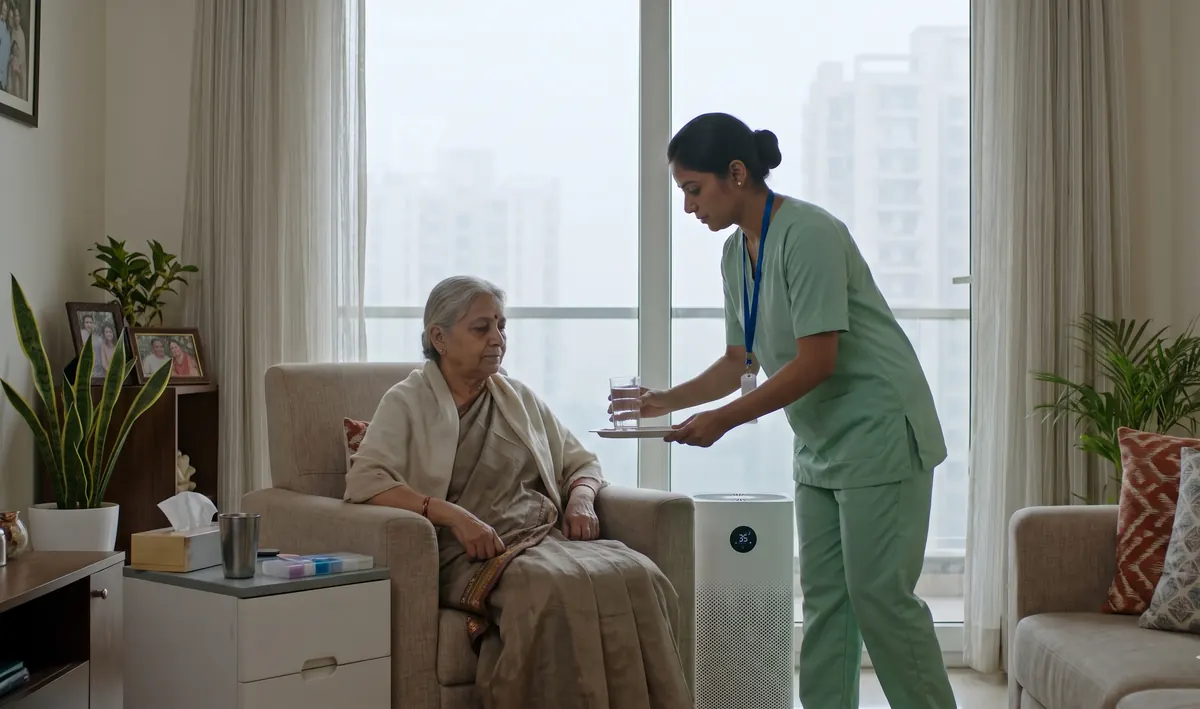
On smoggy days, a trained caregiver who lives in the house can keep the routine steady: medicines on time, warm fluids, a clean and calm room, a notebook of symptoms and a quick message to the family if anything changes. We provide 24-hour live-in care only, so someone is there at night, which is often when breathing problems appear. Our caregivers support daily care and follow your doctor’s advice. They do not replace your doctor or change treatment. We also do not provide physiotherapy.
Read about our Old Age Care service and our Home Nursing Care service.
Understanding the air quality categories
In India, the air quality index is usually reported in six bands: good, satisfactory, moderate, poor, very poor and severe. For a healthy adult, the lower bands cause little trouble. For an older person with a lung or heart condition, even the “moderate” and “poor” days can bring a cough or breathlessness. A simple family rule is to treat the poor, very poor and severe days as “indoor days” for your parent, unless the doctor has said otherwise.
Indoor air matters too. The World Health Organization’s fact sheet on household air pollution and health explains how smoke from cooking fires, heaters and burning fuels can add to the problem inside the home, which is why ventilation and cleaner cooking and heating habits are worth a thought.
Nights and early mornings
Many people with asthma or COPD find that breathing is hardest at night and in the early morning, when the air outside is coldest and densest with pollutants. A few simple habits can help:
- Keep windows closed at night on poor-air days, and make sure the bedroom is warm but not stuffy.
- Raise the head of the bed with extra pillows if the doctor agrees, as some people breathe more easily sitting up slightly.
- Keep the inhaler, a glass of water, a torch and the phone within easy reach of the bed.
- Avoid sudden cold air on waking; sit on the edge of the bed for a minute before standing.
Using simple devices at home, only as the doctor advises
Some doctors suggest a pulse oximeter, a blood pressure monitor or a peak flow meter for patients with lung or heart problems. These can be useful if the doctor explains what the readings mean and when to call. Without that guidance, numbers on a screen can cause either false comfort or needless panic. Ask your doctor which devices are suitable, how often to check, and which readings should make you call. The National Institute on Aging’s guide to medication management is also a handy reference for organising medicines safely.
Looking after mood and company
Smog season keeps many older people indoors for weeks, and they can feel low, restless or lonely. Short video calls with grandchildren, favourite music, a window with some daylight, light hobbies such as sorting photographs, and regular visits from family can make a real difference. A caregiver who lives in the home also provides steady company through long indoor days.
Related reading
- Senior care at home in Delhi in winter and smog: a family guide
- Cold wave checklist for elderly parents living alone in Delhi NCR
- Elderly care services in Delhi: daily support and safety guide
- What is included in 24-hour home nursing care in Delhi
Frequently asked questions
Do air purifiers really help older people?
A purifier may help reduce fine particles in one room if it is the right size and the filters are kept clean, but it is not a cure. It works best along with closed windows and your doctor’s treatment plan.
Can an elderly person with COPD do indoor exercise?
Many people with COPD benefit from gentle movement, but the right amount depends on the person. Ask your doctor what is safe.
Is it safe to leave an elderly parent alone on very poor air days?
It is safer if someone is nearby who can help with medicines and notice changes. If you cannot be at home, consider help with live-in care.
If you need help this winter
If you are worried about leaving your parent alone during the smog season, talk to us. We serve Delhi NCR, including Noida, Gurugram, Ghaziabad and Faridabad.
Call +91-8587808979 or message us on WhatsApp. Visit our Contact Us page to reach us.