
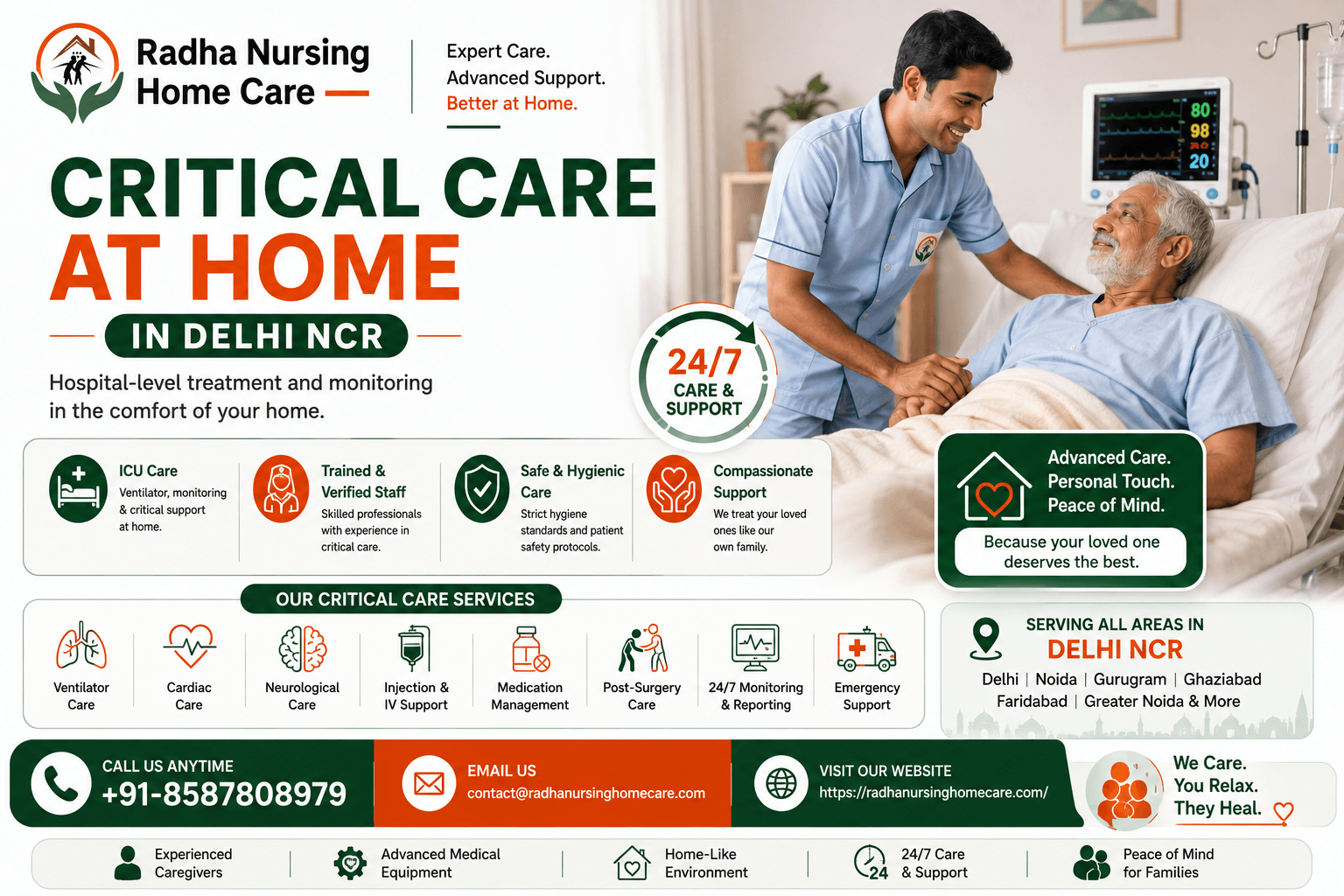
When a patient is discharged from a hospital but still requires close monitoring, families often consider continuing care at home. This can be particularly relevant after intensive care, major surgery, stroke, neurological illness, serious infections, or other complex medical conditions.
One of the first questions families ask is: How much does critical care at home cost in Delhi NCR?
There is no single fixed price because critical care at home can range from professional nursing support to a more complex ICU-style setup involving specialized nurses and medical equipment.
Based on currently published Delhi NCR home-care pricing in 2026, families can encounter costs ranging from approximately ₹2,000–₹3,500 per day for some 24-hour nursing arrangements to ₹6,500–₹14,000 or more per day for advanced ICU-at-home packages, depending on the patient’s medical requirements, equipment, staffing, and provider. These are indicative market figures rather than a universal tariff.
What Is Critical Care at Home?
Critical care at home refers to providing a high level of medical and nursing support to a patient in their home after the patient has been assessed as suitable for home-based care.
It may involve:
- Continuous or frequent patient monitoring
- Professional nursing care
- Oxygen therapy
- Suction support
- Feeding-tube care
- Catheter care
- Wound management
- Medication administration within the nurse’s scope
- Ventilator or respiratory support when clinically appropriate
- Specialized medical equipment
- Coordination with doctors and other healthcare professionals
“Critical care at home” does not mean that every patient needs a complete hospital ICU inside the house. The level of care should be determined by the treating medical team.
What Is the Average Cost of Critical Care at Home in Delhi NCR?
Pricing varies considerably depending on the patient’s condition and the level of professional support required.
For 2026, published Delhi NCR pricing provides some useful benchmarks:
| Type of Care | Indicative Cost |
|---|---|
| Basic 24-hour nursing/care arrangement | ₹2,000–₹3,500/day |
| ICU-trained nurse, 24-hour care | Around ₹2,500/day and upward |
| Specialized 24/7 nursing packages | Approximately ₹60,000–₹1,20,000/month |
| ICU-level nursing + equipment | Approximately ₹95,000–₹1,35,000/month |
| Advanced ICU-at-home setup | Approximately ₹6,500–₹14,000/day |
These figures are examples of prices currently published by Delhi NCR providers and can change according to the patient’s condition, staffing requirements, equipment, duration, and location.
Therefore, families should request a patient-specific quotation rather than relying on a generic online price.
Why Does Critical Care at Home Cost More Than Regular Home Care?
Critical care involves a higher level of clinical responsibility.
A general patient caretaker may assist with bathing, feeding, mobility, hygiene, and companionship. A critical-care nurse may need to monitor vital signs, manage prescribed medical equipment, provide clinical procedures, and recognize changes that require medical attention.
The greater the patient’s medical complexity, the more specialized the caregiver or nurse may need to be.
For example, published 2026 pricing from one Delhi NCR provider lists 12-hour shifts at approximately ₹1,800–₹2,500 for ANM-level care, ₹2,500–₹3,500 for GNM care, and ₹3,500–₹5,500 for BSc/ICU-trained nursing, illustrating how qualifications and clinical complexity can affect pricing.
1. Nurse Qualification Affects the Cost
One of the biggest factors is the qualification and experience of the professional providing care.
Basic attendant or caregiver services generally cost less than professional nursing.
A GNM or BSc nurse with relevant clinical experience may cost more, while a nurse with ICU or ventilator-care experience may command a higher rate.
For patients requiring advanced monitoring, families should not select a provider solely because it offers the lowest price. The professional’s qualifications should match the patient’s clinical requirements.
2. Number of Hours Matters
The number of hours of care has a direct effect on the total cost.
Families may choose:
- Short nursing visits
- 8-hour shifts
- 10-hour shifts
- 12-hour shifts
- 24-hour coverage
A 24-hour arrangement may involve two nurses rotating shifts rather than one nurse working continuously.
Some providers publish monthly 24/7 nursing packages ranging from roughly ₹32,000 to ₹1,35,000 depending on the nursing level and whether ICU equipment is included.
3. Patient’s Medical Condition
The patient’s diagnosis and level of dependency are major cost factors.
A stable post-operative patient who only needs monitoring and medication support will generally have different requirements from a patient who is ventilator-dependent.
Patients requiring complex care may include those with:
- Neurological conditions
- Stroke-related disabilities
- Paralysis
- Respiratory disorders
- Tracheostomy
- Feeding tubes
- Ventilator dependence
- Complex wounds
- Multiple medical conditions
For example, neuro patient care at home in Delhi may involve nursing, mobility assistance, feeding support, pressure-injury prevention, and rehabilitation coordination depending on the patient’s condition.
4. Medical Equipment Can Increase the Cost
Equipment is another important part of the total budget.
Depending on the patient’s needs, equipment may include:
- Hospital bed
- Pressure-relieving mattress
- Oxygen concentrator
- Suction machine
- Pulse oximeter
- Multi-parameter monitor
- Infusion pump
- BiPAP or CPAP device
- Ventilator
- Other prescribed medical equipment
Some published Delhi NCR estimates put ICU equipment rental at approximately ₹15,000–₹60,000 per month, although actual costs vary substantially by equipment type and provider.
Advanced equipment can significantly increase the overall cost.
For example, a ventilator-dependent patient will generally require a more complex setup than a patient who only needs an adjustable hospital bed and routine monitoring.
5. Oxygen Support Can Affect the Budget
Patients who require supplemental oxygen may need an oxygen concentrator, cylinders, or another prescribed oxygen-delivery system.
The cost depends on the equipment, duration of use, oxygen requirements, and whether the equipment is rented or purchased.
Families should ask whether oxygen equipment is included in the quoted nursing package or charged separately.
6. Ventilator Care Is More Expensive
Ventilator-dependent patients require specialized nursing support and appropriate equipment.
The nurse needs relevant experience in ventilator care, airway management, monitoring, and emergency response according to the patient’s medical plan.
Because of this additional complexity, ventilator-based home care can cost considerably more than routine home nursing.
Published Delhi NCR equipment estimates, for example, list ventilator rentals at roughly ₹3,000–₹5,000 per day from one provider, although rates vary by model, duration, and package.
7. Location Within Delhi NCR
The patient’s location can also influence pricing.
Delhi NCR includes Delhi as well as areas such as Noida, Gurugram, Ghaziabad, and Faridabad. Travel distance, availability of specialized staff, and local provider coverage may affect the final quotation.
Some providers advertise uniform pricing across Delhi NCR, while others may apply location-specific charges.
Therefore, it is useful to provide the exact locality when requesting a quote.
8. Duration of Care
Short-term critical care and long-term care may have different pricing structures.
A patient who needs home nursing for two weeks following hospital discharge may be charged differently from someone who requires several months of ongoing care.
Some providers may offer monthly packages for longer arrangements, potentially making extended care more economical than booking individual daily shifts.
Always ask whether the quoted price changes for longer commitments.
What May Be Included in a Critical-Care Package?
Before agreeing to a price, ask exactly what the package includes.
Depending on the provider and care level, it may include:
- Professional nurse
- Patient monitoring
- Medication support
- Personal care
- Vital-sign monitoring
- Wound care
- Catheter care
- Feeding-tube assistance
- Oxygen monitoring
- Equipment coordination
- Care documentation
- Family updates
- Replacement staff
However, equipment, consumables, doctor visits, medicines, laboratory tests, physiotherapy, and emergency transportation may be charged separately.
A recent Delhi NCR provider, for example, lists ICU-level 24-hour nursing separately from equipment-inclusive packages, demonstrating why families should ask for an itemized quotation.
Is Critical Care at Home Cheaper Than a Hospital ICU?
It can be less expensive in some situations, but it is not appropriate to compare prices alone.
Hospital ICU charges include a broader clinical infrastructure, including doctors, emergency facilities, laboratory services, imaging, pharmacy support, and immediate access to hospital interventions.
For context, a 2025 CGHS rate document lists a standardized ICU rate of ₹5,400 per day for specified hospital categories under that schedule; actual hospital bills and private-sector ICU charges can be substantially different.
Home critical care is appropriate only when the patient’s healthcare team considers the patient medically suitable and the required equipment and professional support can be safely provided.
How to Reduce Unnecessary Home-Care Expenses
Families should focus on the care that is actually required.
Get a Medical Care Plan
Ask the treating doctor what level of monitoring and nursing care the patient actually needs.
Separate Nursing From Equipment Costs
Request separate prices for nursing, equipment rental, consumables, and other services.
Compare Qualifications
Do not compare two providers solely on price if one is offering a general caregiver and the other an ICU-trained nurse.
Ask About Long-Term Packages
If care is expected to continue for several months, ask whether a monthly package is available.
Clarify Additional Charges
Ask about:
- Night charges
- Holiday charges
- Emergency visits
- Equipment installation
- Consumables
- Replacement staff
- Doctor visits
- Physiotherapy
- Travel charges
This can help prevent unexpected expenses.
How to Choose a Home Critical-Care Provider in Delhi NCR
Cost should be only one factor when choosing home healthcare services in Delhi.
Also check:
- Nurse qualifications
- ICU experience
- Background verification
- Patient-to-caregiver matching
- Availability of replacement staff
- Clinical supervision
- Emergency protocols
- Equipment quality and maintenance
- Written service agreement
- Transparent billing
Continuity is particularly important for critically ill patients. A recent consumer commission case involving a home nursing agency highlighted the importance of replacement arrangements when an assigned nurse stopped attending a bedridden patient.
How Radha Nursing Home Care Can Help
Families looking for Nursing Care in Delhi NCR can discuss the patient’s condition, required nursing hours, equipment needs, and expected duration of care with a home-care provider.
Radha Nursing Home Care can be considered when exploring home-based nursing and patient-care support. Before starting services, families should provide complete information about the patient’s medical condition so the appropriate level of caregiver or professional nursing support can be considered.
The final cost should be based on the actual care plan rather than a generic package.
Final Thoughts
So, how much does critical care at home cost in Delhi NCR?
As a broad 2026 planning range, families may encounter approximately ₹2,000–₹3,500 per day for some 24-hour nursing arrangements, while ICU-trained nursing and equipment-intensive care can cost considerably more. Advanced ICU-at-home setups may reach approximately ₹6,500–₹14,000 or more per day, depending on the equipment and clinical support required.
The final price depends on the patient’s condition, nurse qualification, number of hours, equipment, location, duration, and complexity of care.
The best approach is to obtain an itemized quotation after a proper assessment. Most importantly, choose a provider based on clinical suitability, professional qualifications, safety, continuity, and transparent pricing, rather than simply selecting the cheapest option.
Frequently Asked Questions
Indicative 2026 prices range widely. Some 24-hour nursing arrangements are around ₹2,000–₹3,500 per day, while advanced ICU-at-home packages can reach ₹6,500–₹14,000 or more per day depending on equipment and clinical requirements.
Published 2026 pricing varies from approximately ₹32,000 to ₹1,35,000 per month depending on nurse qualification, patient complexity, and whether ICU-level equipment is included.
Not always. Some packages include equipment, while others charge separately for hospital beds, oxygen concentrators, ventilators, monitors, suction machines, and other devices. Always request an itemized quotation.
Usually, yes. Critical-care nurses require specialized skills and may be responsible for complex monitoring and medical equipment. Their rates can therefore be higher than those of general patient attendants.
Depending on the patient, equipment may include an ICU-style bed, oxygen equipment, suction machine, patient monitor, infusion pump, BiPAP, or ventilator.
Not necessarily. Continuous 24-hour coverage may involve two or more nurses working shifts. Families should confirm the staffing model before hiring.
Usually, medicines are not automatically included in a nursing package. Ask the provider whether medications, consumables, equipment, doctor visits, and diagnostic tests are included or billed separately.
It can be appropriate for selected medically stable patients when the treating medical team approves home care and appropriate equipment and trained professionals are available. It is not a substitute for emergency hospital treatment when a patient’s condition becomes unstable.
Provide the provider with the patient’s diagnosis, current condition, required nursing procedures, number of hours, equipment requirements, location, and expected duration of care. An assessment-based quotation will generally be more useful than a generic online price.
Families can contact Radha Nursing Home Care to discuss their home-care requirements and determine what type of patient-care or nursing support may be appropriate. The exact service and cost should be confirmed based on the patient’s individual care needs.