
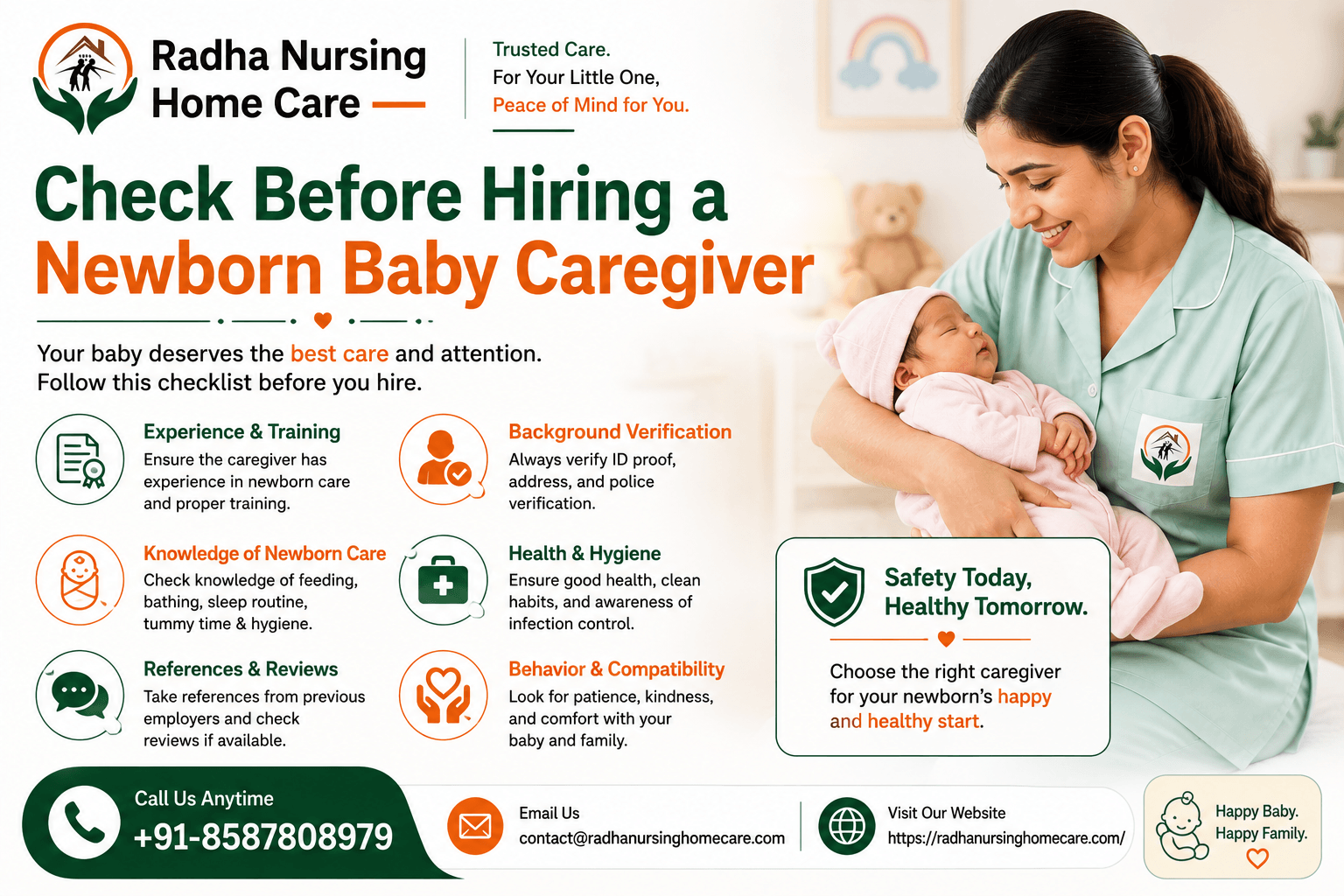
Bringing a newborn home is one of the most memorable experiences for a family, but the first few weeks and months can also be demanding. Newborns need frequent feeding, diaper changes, sleep support, hygiene, soothing, and constant attention. Parents may also be recovering from childbirth while trying to adjust to a completely new routine.
For these reasons, many families consider hiring a newborn baby caregiver at home. A suitable caregiver can provide practical assistance and help parents manage everyday baby-care responsibilities.
However, hiring someone to care for a newborn requires careful consideration. Parents should look beyond availability and cost and evaluate the caregiver’s experience, reliability, responsibilities, safety practices, and ability to follow parental instructions.
If you are searching for a Newborn Baby Care Taker in Delhi, here are the key things to check before making a decision.
1. Check Previous Newborn-Care Experience
The first thing to ask is whether the caregiver has experience specifically with newborn babies.
Experience caring for a toddler or older child does not necessarily mean someone is experienced with a newborn. Babies in the early months have different feeding, sleeping, hygiene, and supervision requirements.
Ask questions such as:
- How many newborns have you cared for?
- How recently did you work with a newborn?
- What age were the babies you previously cared for?
- Have you worked with first-time parents?
- Are you comfortable with frequent feeding and diaper changes?
- Can you follow a baby’s established sleep and feeding routine?
A caregiver who can clearly describe previous newborn-care responsibilities may be easier for parents to evaluate.
2. Understand Exactly What the Caregiver Will Do
Never assume that every newborn caregiver provides the same services.
Before hiring, create a clear list of responsibilities. Depending on the arrangement, these may include:
- Feeding assistance
- Burping
- Diaper changing
- Bathing and basic hygiene
- Dressing the baby
- Soothing and settling
- Supporting the baby’s sleep routine
- Washing and organizing baby items
- Keeping the baby’s immediate area tidy
- Accompanying parents during routine baby-care activities
If household chores are also expected, clarify whether they are limited to baby-related tasks or include general housework.
Clear expectations can prevent misunderstandings after the caregiver begins working.
3. Ask About Infant Safety Practices
Safety should be one of the highest priorities when hiring someone for a newborn.
Ask the caregiver how they approach basic infant safety, including safe handling, supervision, feeding, bathing, and sleep.
Parents should also ensure that the caregiver understands and follows the family’s instructions and current pediatric guidance.
For example, the caregiver should know that a newborn should not be left unattended on a bed, changing table, sofa, or other elevated surface.
Parents should also establish clear rules regarding visitors, smoking, hygiene, handling of the baby, and taking the baby outside the home.
4. Check Hygiene and Handwashing Habits
Newborns are particularly vulnerable to infections, so hygiene is an important part of everyday baby care.
Before hiring, discuss expectations regarding:
- Handwashing before handling the baby
- Clean clothing
- Personal hygiene
- Cleaning feeding equipment
- Handling diapers
- Keeping baby-care items organized
- Staying away from the baby when experiencing contagious illness
A caregiver should be comfortable following the family’s hygiene practices and any instructions provided by the baby’s healthcare professional.
5. Ask About Feeding Experience
Feeding is one of the most frequent responsibilities involved in newborn care.
Depending on the family’s preferences and the baby’s needs, the caregiver may assist with breastfeeding routines, expressed breast milk, or formula feeding.
Parents should explain their feeding preferences clearly and ask whether the caregiver has experience supporting similar routines.
If expressed milk or formula is being used, parents should establish clear instructions for storage, preparation, cleaning, and feeding.
A caregiver should never independently change a baby’s feeding routine, formula, medication, or other medical instructions.
6. Discuss Sleep and Night-Time Care
Newborn sleep patterns can be unpredictable, and night-time care can be particularly exhausting for new parents.
If you are considering a caregiver for night support, ask:
- What are your usual night-shift hours?
- Are you comfortable waking when the baby needs attention?
- Can you assist with diaper changes and feeding routines?
- How do you help settle a baby?
- What will you do if the baby develops a concerning symptom during the night?
Families should establish a clear night-time routine and emergency communication process.
If the caregiver is expected to sleep during part of a night shift, clarify exactly what that means and whether continuous supervision is required.
7. Check Identity and Background Verification
A newborn caregiver may spend many hours inside your home and have direct responsibility for your baby.
For this reason, families should ask about identity and background verification.
If you hire through an agency, ask whether it verifies:
- Identity documents
- Address details
- Previous employment
- References
- Relevant training or certifications
Families should also check references where available.
Verification does not guarantee that every caregiver will be suitable, but it is an important part of a responsible hiring process.
8. Ask for References
References from previous families can provide useful information about a caregiver’s reliability and behavior.
If references are available, ask about:
- Punctuality
- Baby-care experience
- Hygiene
- Communication
- Reliability
- Ability to follow instructions
- Interaction with parents
- Reason for leaving the previous position
Be respectful of privacy when contacting references and focus on professional information relevant to the childcare role.
9. Check Training and Qualifications
Not every newborn caregiver needs to be a nurse. However, parents should understand the caregiver’s training and limitations.
A caregiver may have experience in childcare, newborn care, first aid, or other relevant areas.
If the baby has a medical condition or requires clinical care, parents should consult the pediatrician about whether a qualified healthcare professional is required.
A Professional Nurse services At Home arrangement is different from ordinary newborn childcare. Nurses have professional qualifications and can provide nursing care within their scope of practice.
Parents should never assume that a caregiver or nanny is qualified to perform medical procedures simply because they have experience with babies.
10. Discuss Working Hours Clearly
Decide what type of support you actually need.
Common arrangements may include:
- Part-time daytime care
- Full-time daytime care
- Night-time care
- Extended shifts
- Live-in support
If you are exploring Baby Care Taker Services at Home in Delhi NCR, ask the provider exactly how the working hours are structured.
For 24-hour coverage, clarify whether the arrangement involves one live-in caregiver or multiple caregivers working in shifts.
11. Ask About Replacement Support
Caregivers can become unavailable because of illness, emergencies, leave, or personal circumstances.
This is especially important for families who depend on a caregiver every day.
If you hire through an agency, ask:
- Does the agency provide replacement caregivers?
- How quickly can a replacement be arranged?
- Is there an additional replacement charge?
- Who should the family contact outside normal working hours?
A clear replacement policy can prevent significant stress if the assigned caregiver is unexpectedly unavailable.
12. Discuss Baby-Related Household Duties
Some families want a caregiver to handle only the baby, while others want help with baby-related tasks.
For example, responsibilities might include washing baby clothes, cleaning bottles or feeding equipment according to instructions, organizing diapers, or keeping the baby’s room tidy.
These duties should be discussed before hiring.
Do not assume that a nanny or caregiver will automatically perform general household chores unless this has been specifically agreed upon.
13. Consider Communication Skills
A newborn cannot explain what is wrong. Parents therefore need a caregiver who communicates observations clearly.
The caregiver should be comfortable telling parents about changes such as:
- Feeding difficulties
- Unusual crying
- Changes in sleep
- Vomiting
- Fever or other concerning symptoms
- Changes in normal behavior
- Skin or hygiene concerns
The caregiver should not diagnose medical conditions. Instead, they should promptly inform the parents so that the family can seek professional medical advice when necessary.
14. Make Sure the Caregiver Can Follow Instructions
Every baby has different routines and preferences.
Parents should explain their expectations regarding feeding, sleep, hygiene, visitors, outings, screen use, and handling.
A good caregiver should be able to follow reasonable parental instructions consistently.
It is also helpful to maintain a written daily routine, especially during the first few weeks.
15. Think About Your Baby’s Individual Needs
There is no universal caregiver arrangement that works for every family.
For example, parents of a healthy newborn may primarily need assistance with everyday childcare. A baby who has been premature, has feeding difficulties, or has a medical condition may require a different level of professional support.
In such situations, the baby’s pediatrician should guide the family regarding appropriate care.
If clinical support is required, parents should consider appropriately qualified nursing professionals rather than relying solely on a general caregiver.
Newborn Caregiver vs Nanny: Which One Should You Choose?
A newborn caregiver generally focuses specifically on the needs of very young babies. A nanny may provide broader childcare and can often continue caring for a child as they grow.
If your primary requirement is newborn feeding assistance, diapering, soothing, hygiene, and sleep support, a caregiver with specific newborn experience may be appropriate.
If you want ongoing childcare that will continue into the toddler and preschool years, Nanny Services Delhi may be worth exploring.
Families looking for occasional childcare can also consider Babysitter services in Delhi, but babysitting and full-time nanny or newborn-care services are not necessarily the same arrangement.
What Should Parents Ask During the Interview?
Before hiring, consider asking:
Experience
- How much newborn-care experience do you have?
- What ages were the babies you previously cared for?
Responsibilities
- What newborn-care tasks are you comfortable handling?
- Are you willing to follow our established routine?
Availability
- What hours can you work?
- Are you available for night shifts?
- What happens if you are unavailable?
Safety
- How do you handle a crying newborn?
- What would you do if you noticed something unusual about the baby’s condition?
References
- Can you provide professional references?
These questions can help parents understand whether the caregiver’s experience matches their needs.
How an Agency Can Help
Hiring through a professional home-care provider can give families access to a broader pool of caregivers and may provide additional administrative support.
Families searching for Childcare services Near Me Delhi should compare the agency’s caregiver verification, replacement arrangements, supervision, service terms, and communication process.
Radha Nursing Home Care can be considered by families exploring home-based newborn and childcare support. Before beginning a service, parents should clearly communicate the baby’s age, daily routine, required hours, caregiver responsibilities, and any special instructions.
Final Thoughts
Choosing someone to care for your newborn is a significant decision. Parents should evaluate more than just experience or price.
Before hiring a newborn caregiver, check their newborn-care experience, references, identity verification, hygiene practices, safety awareness, working hours, communication skills, responsibilities, and replacement arrangements.
Most importantly, make sure the caregiver understands the difference between everyday childcare and medical care. If your newborn has specific medical needs, involve the pediatrician and arrange appropriately qualified professional support.
With careful screening and clear expectations, families can find childcare support that makes the early months more manageable while keeping the baby’s safety and wellbeing at the center of the arrangement.
Frequently Asked Questions
Check newborn-care experience, references, identity and background verification, hygiene practices, safety awareness, working hours, responsibilities, communication skills, and replacement policies.
There is no single required number of years for every family. What matters is relevant, recent experience caring for babies of a similar age and the caregiver’s ability to follow safe childcare practices.
Not necessarily. A caregiver generally provides everyday childcare, while a nurse provides professional nursing care. If your baby has medical needs, consult the pediatrician about the appropriate professional support.
Yes, some caregivers offer night shifts or extended care. Parents should clarify working hours and responsibilities before hiring.
A newborn caregiver typically specializes in the needs of newborns and young infants. A nanny generally provides broader childcare and may continue caring for children as they grow.
Yes. When available, professional references can help you understand the caregiver’s reliability, experience, communication, and previous childcare responsibilities.
This depends on the agreement. Parents should clearly define whether the caregiver is responsible only for the baby or also for baby-related tasks such as washing baby clothes and organizing baby items.
Ask about the agency’s replacement policy before starting the service. If continuous childcare is important, having a clear replacement arrangement can be especially valuable.
You can compare home-care agencies and childcare providers offering newborn support in Delhi NCR. Evaluate their caregiver experience, verification process, service terms, availability, and replacement support before choosing a provider.
Home-based childcare can be appropriate for many families when the caregiver is suitable and the home environment follows safe infant-care practices. Babies with medical or special care requirements should receive guidance from their pediatrician and appropriately qualified professionals.